


For more than a decade, Romy Trono has been tracking the fate of the dugong, initially as project leader of the Department of Environment and Natural Resources’ Pawikan and Dugong Conservation Project before joining WWF Philippines and Conservation International. His assessment of where the species stands nationally is alarming.
“The dugong may be edging toward extinction across the Philippines,” he expressed in a worried tone.
Research literature points out that the dugong population has now been reduced to small, fragmented pockets in select places, including Palawan, Eastern Mindanao, Sarangani, Panay, and Aurora, with only Palawan having the most significant remaining population.
The main factors that put the dugong at risk are believed to be the reduction and disappearance of seagrass beds that serve as their source of food, including destructive typhoons attributed to climate change. The dugong’s biology requires an undisturbed environment and habitat. Female dugongs do not reach sexual maturity until they are about nine to 11 years old. They are known to give birth to only a single calf every three to five years, giving them one of the slowest reproductive cycles among marine mammals in Philippine waters.
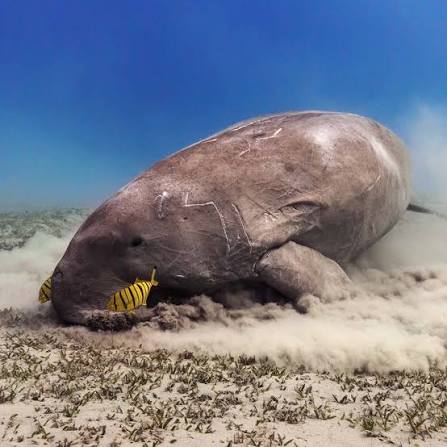
The sparse scientific knowledge about the species’ biology, movement, and distribution is a gap recognized even by conservation experts. Trono points out that while the national dugong conservation plan was being written, at least 11 mortalities were recorded nationwide during the period. Given that their reproductive cycle is counted in years rather than months, such a loss is difficult for the remaining population to absorb.
Exactly how many dugongs remain in Palawan’s waters is, in itself, an open question. The Philippines has not conducted a nationwide population survey since 1998.
“Since then, hindi natin masabi kung tumaas o bumaba yung population natin,” said Dr. Teri Aquino, a Palawan-based veterinarian and board member of the Marine Wildlife Watch of the Philippines. Since then, she said, there has simply been no way to say whether the population has grown or shrunk. What exists instead is a patchwork of localized sightings, drone counts, and community reports that capture a sliver of the picture.
The disappearance of seagrass beds is a concrete problem playing out nationwide but with significant consequences in Palawan, given the scale of the population it is still believed to support. In December 2021, when Typhoon Rai, known locally as Odette, tore across the province’s coastline with record-strength winds and storm surge, seagrass beds in places like Roxas and Dumaran in northern Palawan, where dugong sightings were frequent, were wiped out.
What kills a dugong
“Yung threats talaga ng dugong is habitat loss,” Jovic Fabello, spokesperson for the Palawan Council for Sustainable Development (PCSD), said. Part of the problem, he explained, is that people do not fully understand how directly protecting habitat protects the species itself. Seagrass beds, the dugong’s feeding grounds, are not spread evenly along the coastline, he explained, and they exist only in specific areas.
A second driver, he said, is more directly human: fishing and other economic or social activities that encroach on dugong habitat. When deaths do make it onto social media, he said, the reported causes cluster around a few recurring patterns, including entrapment in fishing nets, boat strikes from a vessel’s propeller or keel, and, in some cases, deliberate hunting for food or other purposes.
Boat strikes, nets linked to dugong deaths as enforcement gaps flagged in Palawan
Dirk Fahrenbach, who runs a dugong-watching operation in Busuanga, cautioned that for most reported deaths, “no one really knows the exact cause.”
In his experience, the biggest threats are drift nets, the nylon lines used in seaweed farming, dynamite fishing, and fast-moving speedboats.
Trono argues that the dugong’s near-invisibility in the Philippines is a problem. Most conservation responses, he points out, remain reactionary. He urged that the dugong should be treated as a flagship species, one whose profile could pull attention and resources toward protection the way species like the tamaraw or the Philippine eagle already do.
As the largest grazer of seagrass, dugongs functionally help maintain the meadows they depend on. Their excretions cycle nutrients back into seagrass beds, and their grazing patterns are associated with greater seagrass species diversity and healthier growth. Fish, including commercially important juvenile species, have been observed moving into freshly grazed patches to feed on organisms exposed in the disturbed sediment.
Roxas: Where the protection ends
Roxas sits along Palawan’s eastern seaboard, a municipality of small fishing barangays whose waters have long been part of the dugong’s range. If Palawan is the species’ best remaining chance nationally, Roxas is a test of whether that chance is being recognized on the ground. Yet it has no dedicated dugong protection or monitoring program, even as dugong deaths and close calls have piled up in recent years.
Interviews conducted in Barangay Malcampo and Barangay 1, two of Roxas’s coastal communities, show both how much local knowledge exists about the dugong’s decline and how little institutional support has arrived to act on it.
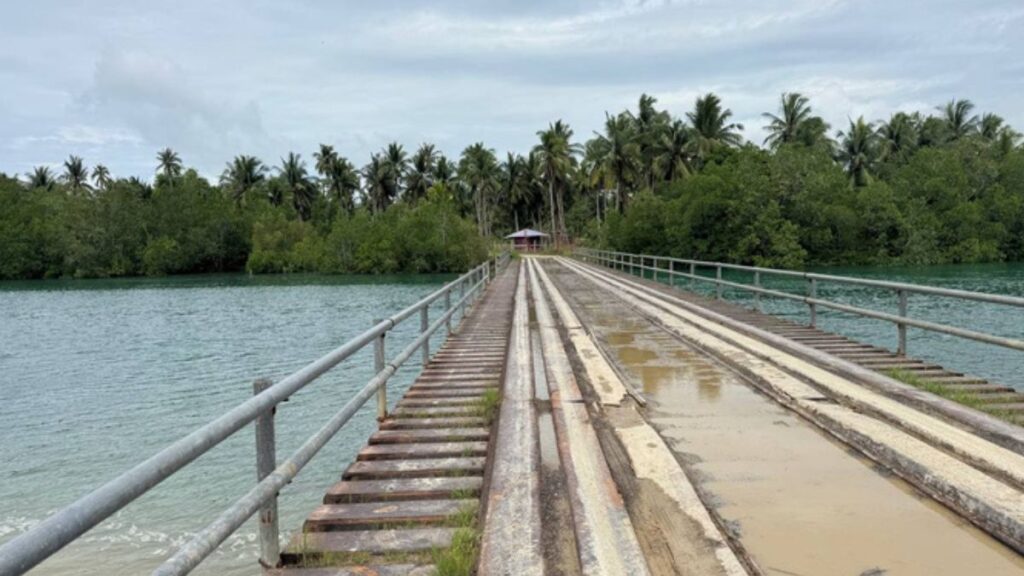

Barangay Captain Richmon Saklet Dagumboy of Malcampo has overseen the community’s Marine Protected Area since he took office in 2013.
“Masasabi ko po ang ating Marine Protected Area ay patuloy po natin pinoprotektahan,” he said. Dagumboy pointed out that their MPA remains actively protected, largely through community effort rather than external funding.
Still, the effort runs on scarce resources. The barangay’s own patrol boat, provided years ago through the Department of Agriculture’s Philippine Rural Development Project, was damaged by successive storms and remains under repair. When wardens need to patrol the MPA, they borrow boats from local fishers. Fuel and boat maintenance are paid for out of the barangay’s small internal revenue allotment. Dagumboy said their enforcement efforts lean heavily on the fisherfolk themselves, who report suspected illegal activity to community sea wardens known as Bantay Dagat and Gabay Dagat. Since designated fishing zones were set up in coordination with those wardens, he said, the barangay has not observed the more destructive practices.
The MPA has drawn outside recognition before from the Department of Agriculture when the barangay once received close to ₱80,000 during a national selection. The award inspired what is now Malcampo’s annual Isda (Fish) Festival. A parallel effort to diversify fisherfolk income, a floating fish-cage-and-cottage project, was destroyed in the 2021 storm and never recovered. “Yun po ay sayang po yung nabigay sana na livelihood,” Dagumboy said of the loss, a wasted opportunity, in his words, for supplemental income that never came back.
Seagrass in the MPA followed a similar arc. “Sa ngayon po unti-unti pong bumabalik yung seagrass bilang pagprotekta doon sa mga dugong,” he said.
In 12 years as captain, he estimated the barangay has attended only one or two trainings specifically about dugongs. “Sa ngayon po talaga ay wala pa kaming natatanggap na tulong na galing sa national,” he said. To date, the barangay has received no dugong-specific support from the national government, despite submitting funding proposals when asked. He said the barangay holds no data at all on the local dugong population.
A few kilometers away, in Barangay 1, Barangay Captain Ariel Zambales describes their relationship with the dugong. Fishing in Roxas, he said, is seasonal and unpredictable, but the habagat, the southwest monsoon that runs roughly from June through September, can shut down offshore fishing for weeks at a stretch, with no alternative livelihood to fall back on.


It was during a low-tide lobster dive, sometime around eight in the morning, that he first saw a dugong up close, a small calf, he estimated at around ten kilograms, with its mother, in shallow water exposed by the receding tide. “Wala lang. Tinignan lang namin,” he said of the encounter. His sibling reported a separate sighting of a different mother-calf pair the same year, 2024.
Both sightings, he said, came after a particularly difficult stretch for the area’s seagrass. Before the 2021 typhoon, dugongs were a common sight.
“Talagang marami,” truly plentiful, he said. The storm wiped the seagrass out almost entirely. Recovery took roughly two years, coinciding with the 2024 sightings. The respite was brief, but a subsequent storm, Typhoon Tino, set the seagrass back again. “Oo, nawala na naman siya,” he said of the seagrass.
Before the 2021 typhoon, he said, his community had worked directly with C3 Philippines, a non-government group that also runs conservation programs in the Calamianes island group farther north in Palawan. Together, he said, they surveyed and measured nine of what researchers had identified as roughly a dozen or more seagrass species present in Barangay 1’s waters. The seagrass, he recalled, was once so dense it fouled boat propellers along stretches his father regularly crossed. Then the storm hit.
“Almost seagrass talaga yung area na yan dati. Nakakalungkot nung Odette, talagang na-wash out lahat,” he said.
What Roxas experiences on the ground is largely confirmed by the PCSD as the state of dugong governance in Palawan.
“Yung Wildlife Act which is a protection ng species, protection ng kanilang habitat, and yung mga rescue operations. But for the program, wala pa talagang full programs in terms of governance,” he said. Protection rests on the Wildlife Act, covering species protection, habitat protection, and rescue operations, but a full governance program for the dugong, he acknowledged, does not yet exist. (with reports from Gerald Ticke, Emman Magpusao, and Celeste Anna Formoso)
*** This story was produced by Palawan News with support from the Earth Journalism Network (EJN).


