


The Philippines is being reimagined thousands of kilometers away from home.
In Melbourne, two Pinoy restaurants are introducing Aussies to Philippine flavors in very different ways. One restaurant aims to preserve the roots of a beloved ingredient, while the other is exploring the potential of Filipino cuisine in Australia.
Together, they illustrate how food is becoming a cultural bridge between Australia and the Philippines, introducing tastes and traditions to diners with no Filipino roots.
At Halaya, a café that is popular on Sprint Street for its ube-based cakes, pastries, and desserts, owner Elbert Estampador has watched the customer mix change over the years.
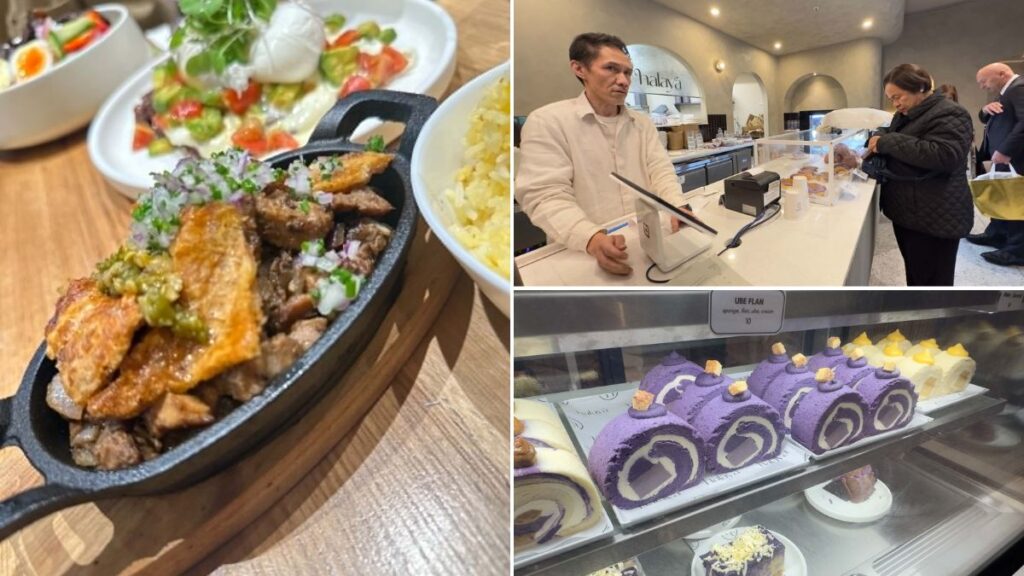
“I guess, ang mix dati is almost 80% Filipino. Now, nagbabago yung dating ratio. Marami nang pumupunta na mga Hapon, Indonesian, lalo na yung mga mas bata (I guess our customer mix used to be almost 80% Filipino. Now the ratio is changing. We’re seeing more Japanese and Indonesians coming in, especially younger people),” he said.
Estampador estimates that at present it is 40-60, with Australian and other migrant communities increasingly drawn to Halaya’s signature purple-colored products.
But for him, ube’s rising popularity presents both an opportunity and a challenge.

“One day, I think it will be popular as matcha, if not more,” he pointed out.
“Pero ang mas maganda sanang mangyari is hindi lang maging trendy ang ube, kasi culture natin yung ube. Sana ma-promote na it is our culture, hindi lang siya trendy tapos biglang mawawala (What I would like to see is for ube to be recognized not just as a trend, but as part of our culture. I hope people understand its cultural roots and that it does not simply become a passing fad),” Estampador added.
The foreign services corps of the Department of Trade and Industry (DTI) said recently that the country “exported nearly 1.7 million kilograms of ube products valued at more than $3.2 million” in 2025.
“This represents a 20.4% increase compared to 2024,” it said.
Palawan News reviewed government data but found no publicly available figures showing how much Philippine ube has been exported to Australia. But the Department of Trade and Industry (DTI) said most of the supply came from Negros, Mindanao, and Bohol, with processing carried out in Aklan near Boracay.

Estampador’s concern shows a broader conversation taking place among Filipinos abroad as ingredients, such as ube, gain international attention.
He stated, “ube is originally from the Philippines,” but believes that the narrative about its origin is losing traction.
Maintaining the Philippines’ position in the ube market, Estampador said, will assume greater importance as demand continues to expand.
“Sana mamaintain ng Philippines yung ube na supply (I hope the Philippines can maintain its supply of ube),” he added.
“Kasi lahat ng Southeast Asia meron ng ube ngayon. So baka maunahan na naman tayo (Many countries across Southeast Asia now have ube, and there’s always the possibility that they could overtake us),” he emphasized.
Victoria’s Member of Parliament Wayne Farnham said Filipino cuisine is gaining wider recognition as Filipinos introduce Australians to their culture.
“Australians, I think, were a bit naive to Filipino culture for quite a while, but it actually is starting to kick off,” Farnham said.
He credited the Filipino community itself and Halaya for helping drive that interest.
“The Filipino community itself is promoting Filipinos, which is great,” he said.
“As you can see, it’s (Halaya) actually pretty full. So it’s not bad. Filipino culture is catching on,” Farnham added, looking around the busy café.
On Racing Club Lane, the approach is different at Serai, one of Melbourne’s most recognized Filipino dining destinations. The restaurant takes its name from the Malay word for “lemongrass.”
Founded in 2022 by Chef Ross Magnaye and partners, Serai has gained attention for combining Filipino flavors with Australian ingredients and contemporary techniques.

Sous chef Keizha Arellano said the restaurant was never intended to simply replicate traditional Filipino dishes.
“Our aim is to really put in the Filipino flavors somehow,” she said.
The menu includes dishes such as cabbage tocino, kangaroo kilawin, and redefined versions of kare-kare.
For many Filipino diners, the approach initially comes as a surprise.
“How is your food like that?” Arellano recalled some customers asking when they first tried the kangaroo kilawin served atop bone marrow.
But she believes Filipino cuisine must continue evolving.

“We’re not trying to move backward now. We’re trying to move forward with it,” she said.
Like Halaya, Serai is also serving a customer base that extends far beyond the Filipino community.
“Mainly Australians. Mainly non-Filipinos,” she replied when asked about the restaurant’s clientele.
She views that growing interest as an opportunity to introduce people to a cuisine that remains underrepresented globally despite the size of the Filipino diaspora.
“I just want them to try Filipino food,” she said.

“We only know adobo. We only know kinilaw at the moment. But there’s more into it,” she added.
Arellano said the popularity of ube should also draw attention to other Filipino ingredients and products that remain largely unknown outside the Philippines.
“Not just about ube, to be honest. And not just about pandan. Not about calamansi. But we have a lot,” she said, pointing to ingredients such as kamias and products such as lambanog that she believes deserve wider international recognition.
Serai manager Alexander Conway said first-time diners are often surprised by the restaurant’s approach.
“The fusion between Filipino and Australian cuisine always surprises new clientele, but they come out happy,” Conway said.
The rise of restaurants such as Halaya and Serai comes as Australia and the Philippines mark 80 years of diplomatic relations this year. While government discussions often focus on defense cooperation, trade, and migration, food is emerging as another avenue connecting the two countries.
For Estampador, preserving the story behind Filipino ingredients remains important as they gain popularity abroad.
For Arellano, innovation is helping Filipino cuisine reach audiences who may otherwise never encounter it.
Despite their different approaches, both share a common goal: ensuring Filipino culture is seen, understood, and appreciated beyond the Filipino community.
In Melbourne, that effort is taking shape, one serving of kangaroo kilawin and one slice of ube dessert at a time.


