


There are gigs you plan for weeks, and then there are the ones that ambush you on an ordinary night and leave you wondering why you don’t do this more often. Last Saturday night at Wanderlust was the second kind.
I found myself in an impromptu jam with Rannie Raymundo. If you need a moment to let that sink in, I understand. This is the man who, by his own account, was playing drums for Kundirana at 15, joined the singers a year later, and started writing songs in 1983. That same ministry produced Gary Valenciano, Ogie Alcasid, Randy Santiago, and Dingdong Avanzado. He wrote “Tatlong Beinte Singko” for Dingdong when he was only 17. He has since written for himself and for others, recognized multiple times by the Awit Awards for his contributions to OPM. He told me he stopped counting his compositions five years ago, after over a thousand songs.
“f you open up my body, you will find jazz,” he told me. Most of his jazz and avant-garde work only circulates in certain circles, some recordings exist only as bootlegs. At the bar the other night, we hatched a plan for a proper concert together. Details still to be ironed out, but the intention is real, and that’s how the best shows begin.
We kept the conversation going after he got back home, the way musicians do when the playing is done but the music hasn’t quite let go yet. He pulled up a clip and sent it my way: him and Noli Aurillo performing Gary Granada’s Mabuti Pa Sila. What they did with it had no rails, a full avant-garde exploration that used the song as a launching pad rather than a destination. It was the kind of performance that reminds you that jazz, at its most honest, is less a genre than a posture toward music itself.
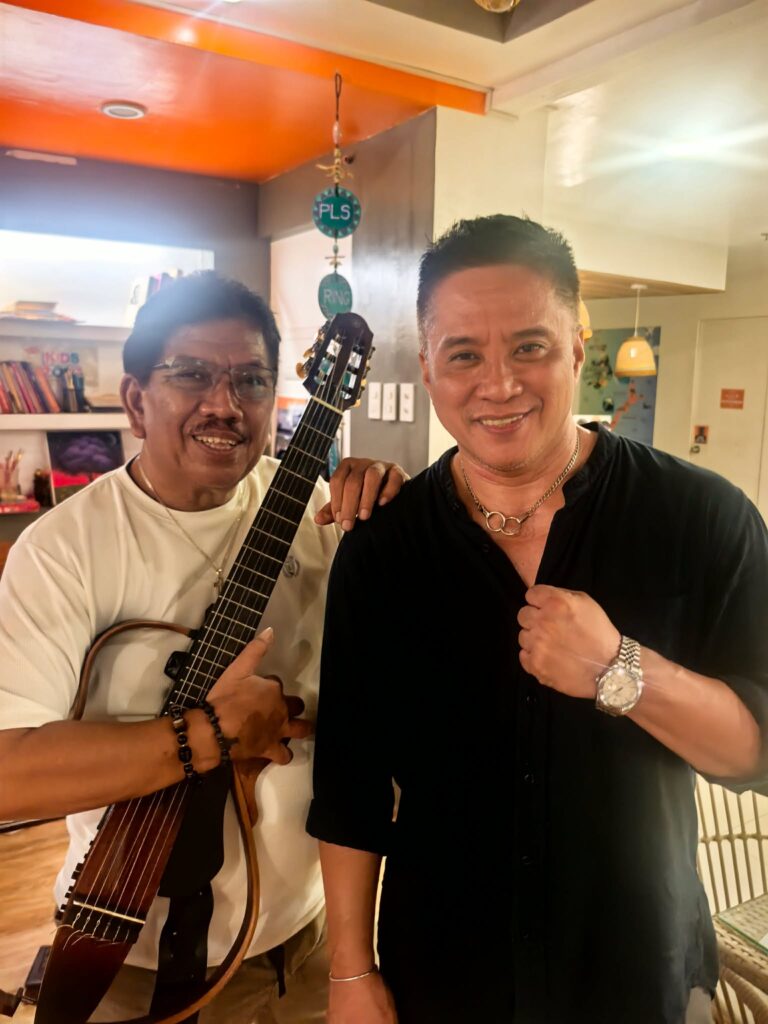
The funny thing is, we had been circling the same orbits for years without ever meeting. Back when I was on the fringes of the Manila music scene during my conservatory days, we moved in overlapping worlds. Some of the same friends, in the same circles. I was a working student then, teaching guitar at the Yamaha School of Music, writing arrangements, doing what one does when music is both your passion and your means of staying enrolled. One of those shared connections was Ben Escasa — my childhood friend and classmate at the PWU conservatory, a songwriter of natural talent whom we lost too soon. Ben would have loved that night. He would have made fun of both of us.
I had long traded the arranger’s pen for a reporter’s notebook, not because the music stopped but because I found another way to tell stories. Journalism has its own kind of composition – structure, rhythm, the search for the true note in a sea of noise. The guitar never left me, it just moved to the side of the desk waiting for nights like that to remind me it was still there.
Rannie once said that when he writes, the objective isn’t to impress but to inspire. It is the same truth for journalism. Not every story moves people, but the ones worth writing always try to.
We both felt it that night. And that concert is coming. Watch this space.


